Our latest “Document of the Week” was chosen by our Academic Liaison Manager, Dr Catherine Bateson. It is a ballad poem from a book of anti-Corn Law rhymes written in the early 1830s.
The Corn Laws were undoubtedly one of the biggest domestic policies in early nineteenth century Britain, impacting significant proportions of the British and Irish populace between their introduction in 1815 to their welcomed repeal in 1846. Brought in initially to protect against cheap grain imports flooding the market following the conclusion of the Napoleonic Wars, the Corn Laws gave rise to high food and goods inflation, particularly seen with the price of bread, as a lack of grain imports and low domestic yield took hold. This led to rioting and impassioned anti-Corn Law leagues advocating for free trade. One such group were the Sheffield Mechanics’ Anti-Bread-Tax Society, who produced a 27-page pamphlet containing six ballad poem rhymes criticising Corn Law policies and the consequences they were having on everyday lives. One poem was simply entitled “Oh Lord, How Long?”, indicating the sense of frustrated feeling some 16 years into this crippling economic and trading stance.
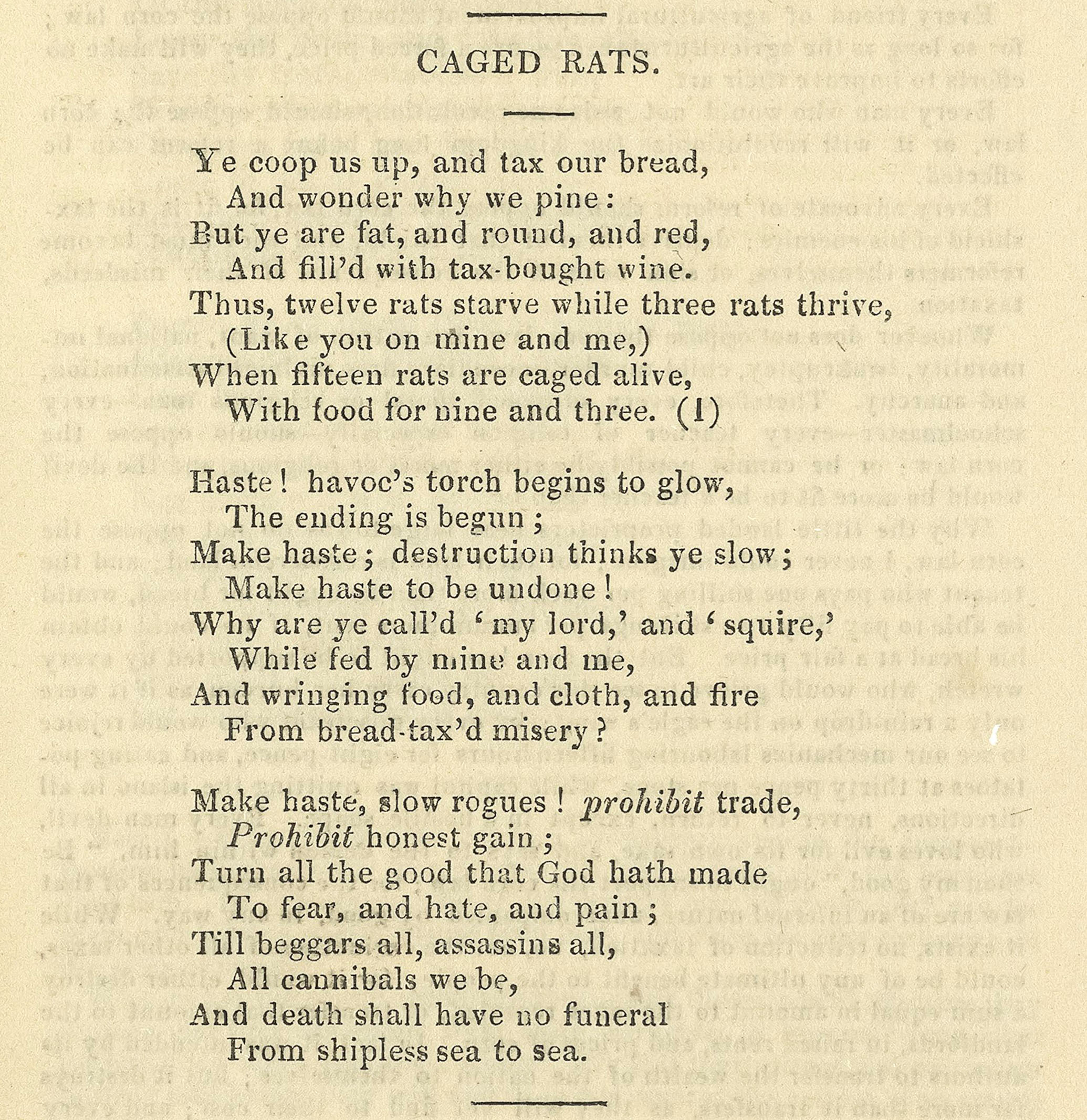
This week’s primary source example highlights “Caged Rats”—the shortest poem in the pamphlet’s collection. Describing the British population as being like trapped vermin and having to cope with scraps of expensive grain, its verses criticised the fact that tax money was going to fund wine, food, and enrichment for those profiting off the Corn Laws. “Ye coop us up and tax our bread, / And wonder why we pine”, it stated, while simultaneously warning that this “bread-tax’d misery” could not be endured anymore. The poem explained that growing discontent would eventually bring down the system: “havoc’s torch begins to glow, / The ending is begun” it suggested, implying violent means were necessary to get the British government to change policy. Each poem was accompanied by extensive explanatory notes—for “Caged Rats” the author explained that “the thing wanted is ‘Bread’: in exchange for cottons, woollens, and hardware”. It reveals how years of Corn Law restrictions impacted not just foodstuffs but also other basic goods traded around the country.
Likewise in the wider pamphlet’s opening declaration, the Sheffield Mechanics’ Anti-Bread-Tax Society’s Secretary, John Carr, criticised the “corruptionists” profiting off grain monopolies and upholding the law. Unless a repeal came soon, Carr lamented that ordinary people would be forced to migrate abroad. Collectively, these poems provide an impassioned window into how the Corn Laws constrained the nation economically in the first decades of the 1800s with significant social consequences—as Carr suggests, “it [was] an act of national suicide to restrict the exchange of manufactured goods for corn […] a law which restricts the necessaries and comforts of life, profits and wages” for all.
Where to find this document
This image comes from our primary source collection, Radicalism and Popular Protest in Georgian Britain, c. 1714–1832. The collection contains a range of differing primary source material types—including pamphlets and broadside balladry—that examine areas of protest, dissent, activism, unrest, conspiracies, rebellion, and grievances in Georgian Britain. The sources spotlight numerous agricultural, social, political, and economic grievances generated by the Corn Laws in the first decades of the nineteenth century. Visit the collection page to learn more.